


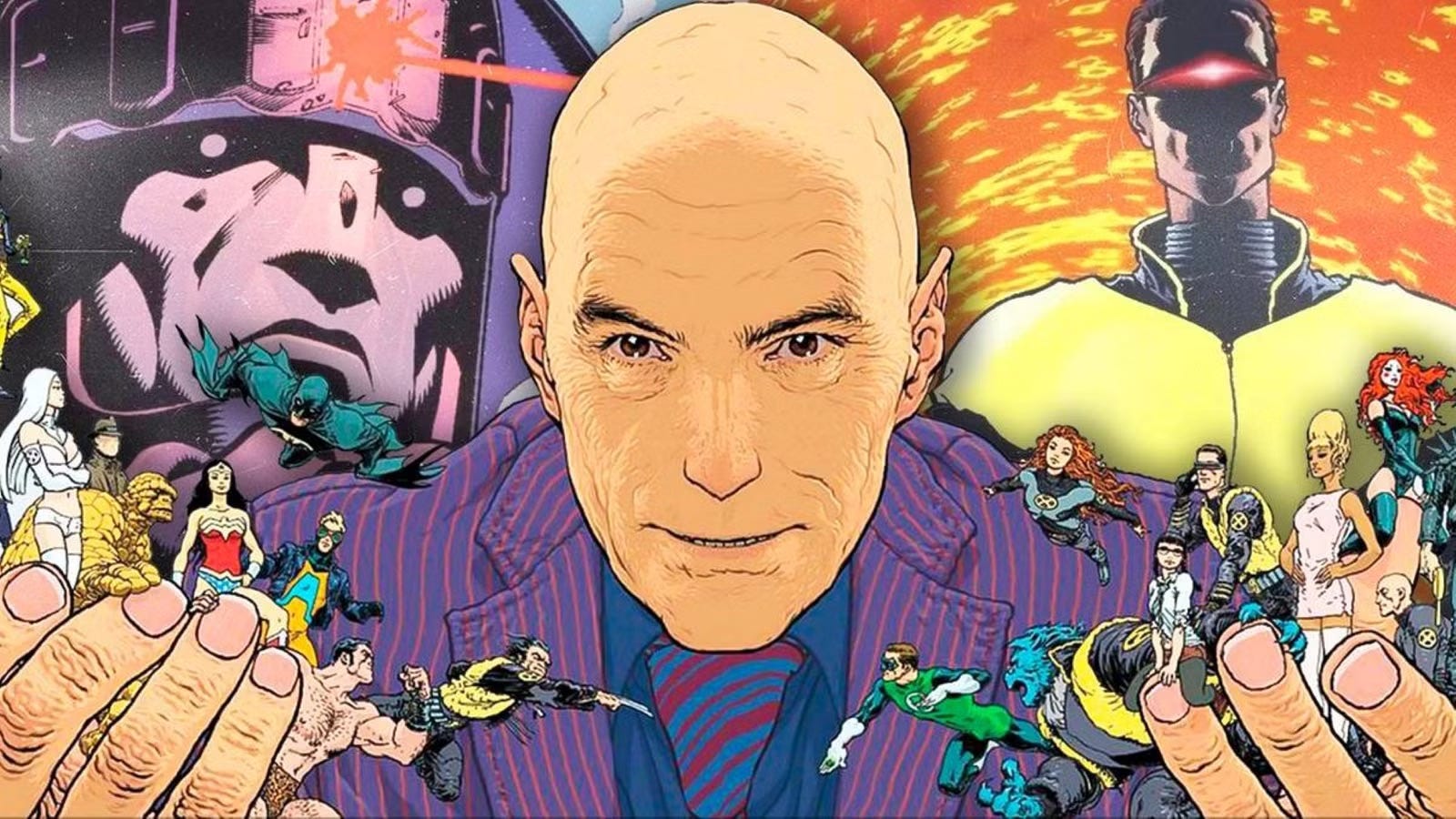
Today we’re continuing our series of [BEST OF] posts to celebrate the 5 year anniversary of 3 Worlds / 3 Moons. And today we’re got a great one, re-visiting Jonathan’s conversation with Grant Morrison.
But before that: some of you may have received a renewal notice for your Circle/annual subscriptions- that was auto-sent in error. We’ve already extended everyone again and will do so until we have an update on 3W/3M [ONE] shipping (as an aside: books are all still at printer, and we are trying to get an exact ETA now, but it will definitely be some time here in the fall, about half the books involved are already done there). Apologies for the confusion there!
For today, enjoy listening to this one. It was our first attempt at the livestreaming/podcasting part of this whole project and needless to say we learned a lot. It took some time to figure out how to host these as subscriber exclusives, and the huge turnout brought down the servers of our audio partner. Luckily, the conversation itself was great enough to make up for the technical difficulties. So much good stuff in here.
Here it is again, in both audio and transcript form…
JH: Hi, I’m Jonathan Hickman, and I definitely want to thank everyone for being here and supporting this little storytelling experiment of ours. Mike Huddleston and Mike del Mundo and I have been incredibly blown away by your generosity and the adventure of all of this. So, in that spirit, let’s see if we can have a little fun today. Obviously, our guest is Grant Morrison, who is an institution in the comic book industry. Their reputation as a storyteller is unequaled and unparalleled. Grant is my favorite writer, and I take great comfort in not being alone in that sentiment. Thank you so much for doing this, Grant. How are you buddy?
GM: Oh, pretty good, and thanks for the intro. I sort of feel as if I'm only an institution in the sense that Arkham Asylum is an institution.
JH: So I did want to ask, are you home? Are you in LA? Are you splitting time still? What are you doing?
GM: No, I mean we're not allowed to travel to America anymore which is killing me, honestly. The last time was in early November 2019, then COVID came along and we're not allowed to leave the country and go back. So, I’ve got a house there in West Hollywood and the place is just rotting away quietly in the sunshine. Friends are going up and doing their best to feed the plants but it's weird: it's the first and longest time I haven't been there.
JH: Oh, well, you know, hopefully-
GM: Honestly, Scotland's been lovely. It's been a fabulous summer, it's beautiful, it's very clean and clear out here in the country. So, now I can't complain but honestly, I really do miss getting over to LA and hanging out with my friends.
JH: Yeah, I'm in South Carolina and it's been pretty peaceful. I mean, we live out in the country and it hasn't been much different than how our normal life is, outside of how it's affected everything tangentially and it’s- you know, everybody just wants out of this thing, right?
GM: The writer's life has always been one of self isolation, so I think we're kind of prepped for it.
JH: Oh, I probably should say to everyone upfront. We asked you for a bunch of questions, and you didn't disappoint. There were a lot of them. Grant and I looked through everything and there were quite a few that either hit the same note or resonated with one or the both of us. I’m gonna try and mash up a bunch of questions that were thematically the same kind, to distill down to what the real question was. All of those are coming, but I wanted to ask a couple of housekeeping questions kind of up front- and really, this first one is the one I want to know the answer to the most, which is: Grant, what are you working on now? Like, what have you got cooking? What's the next year look like for you?
GM: Well, it's all kind of secret stuff right now. I've got two TV shows I'm working on, one that we just sold a couple of months ago and I'm sure we'll hear about these. And I finished a novel this year, that was my COVID year. I actually managed to write a novel for the first time since I was 19 years old.
JH: Nice.
GM: - that's coming out from Random House next fall. So that's kind of been my work and it's not so much comics, although there's a whole bunch of ideas that have been brewing. I kind of finished up the work at DC with the Superman and The Authority book, which I've had a really good time with. But that’s been it. There's a whole bunch of stuff right now, I've been working just on the TV stuff and the book.
JH: Are you working with Brian Taylor again or is this a whole different enterprise?
GM: Yeah, that's a whole that's a whole different thing. You know I mean I love Brian. I love what he did with Happy! It was just like an amazing collaboration, but, yeah, this is just another branch of the, you know, the side hustles.
JH: Yeah, yeah. Of course. Of course.
GM: Are you mostly working on the 3 Moon stuff or are you- is this your thing for the foreseeable future?
JH: I'm in the same boat: I've sold a bunch of stuff in LA and we're doing that dance of revisions and who we're partnering with and all of that, but this is the thing that I'm doing right now- I still have some Marvel work I'm gonna do- but this is the thing that I’m doing that's the really interesting experiment. Like, how all this works digitally and what it means to be able to deliver stuff at a moment's notice. You know, drop a whole album, if you will.
GM: Absolutely. I find the whole thing quite fascinating and we can talk about that, but is this an idea you've had for a while, or is it something you've just come to do as something that's kind of building on what you've done before?
JH: I've been trying to think of the best kind of example of what it is, and the thing that I keep landing on is- it's kind of like a cooking show, Grant?
GM: Yeah, great! We need way more cooking show comics. And in what way? I mean, obviously you're going to have to unpack that.
JH: So it's obvious that we're going to make a story right? We're going to have dinner.
GM: Yeah.
JH: But we're really waiting to see what all the ingredients are whenever we talk to the audience, and we're developing it in front of them. And it's interesting because they’re- everybody's commenting on everything as we post stuff and it kind of spurs different ideas and it takes things in- not huge different directions, obviously, I know where i'm going. But it's really interesting in the feedback loop of it. And so we're just kind of going to play, and see how it goes. See what comes out of the oven, you know?
GM: Yeah, so I guess you kind of know the ingredients that are going in so you know it's either going to be a spicy dish or not, or is that something that remains to be seen?
JH: Well, I would say to absolutely butcher the analogy, we know we're cooking Italian, right? But whether we're actually going to be a particular dish or not is what we're not sure about. Will it be one narrative, or will there be lots of little stories that actually interconnect. Will we fall in love with a different character and just you know go off on a tangent with that? So it's really experimental.
GM: No, I know it sounds kind of fascinating, and I'm interested in the feedback effect as well. Where the audience is part of the show and it has that live performance feel that I always enjoy in a comic.
JH: So let me ask you this because this is probably a good place and something that people want to hear about, because you're really asking- what's our origin point, right? And so I think it's a fair question- how do you actually start your writing process? What's the lightning bolt? Do you see a cold open? Do you get the ending? Do you hear the voices or see a glimpse of a character? How does idea origination start with you?
GM: Well, I guess it's a bit of all that one. It's usually a feeling or something, you know? It tends to be all of the stories are autobiographical in the sense that I'm talking about what happened that day in my life- and sometimes it can be massive events like a death in the family, sometimes it can just be thoughts that have been triggered by stuff you've read or seen on television. But it always starts as a kind of feeling that I want to express about today, and how it feels to be living today, and specifically not just today in the sense of our times, but specifically moment to moment, what am I feeling? How can I transform that into symbolic content or into metaphors that talk about these things? So it comes from that, and for me, it's always the metaphor of music: that I know when it's right- when it sounds right. And sometimes it can sound very- even if it's a little dissonant or if it's a bit weird, or you know it's operating in different scales from the traditional- but it's always about the sound of it. Does it capture the feeling? And I think for me- and I'm interested in how you approach the concept of world building-- but for me it's like the world is built around a feeling and that can be of nihilistic despair like in something like Nameless.
The metaphors and the colours and the notions kind of accumulate around what I'm trying to express, whatever that particular idea or feeling or note is and then the storytelling process starts and it's, what is the framework? What is this like? You know, what I usually think is, is this a myth? Is this Jason and the Argonauts? Is this Romeo and Juliet? Is this Hamlet? And there's always something it’s kind of like, and that becomes part of the foundation as well. Then I'll build in something- like in The Filth, it was the kabbalistic structure, but applied to a notion that was a little like Jerry Anderson's Captain Scarlet. I was doing this weird anti-anti-kabbalistic qlippothic colour hierarchy in this organization, but as I said, all of everything is just about how to accrue more and more detail that makes that particular feeling more and more palpable, if that makes sense.
JH: It does.
GM: Further to that, in that sense, I don't create the world completely from the outside in, I kind of build it up from the inside out. And also a lot of the seeming work is suggestive of stuff. I never quite go there, because I love the notion of mystery and of the audience coming up with their own ideas of what lies beyond the final boundary. In the Klaus series with Santa Claus, there's the whole thing about the moon, the lunar civil war- and honestly, even I don't know what happened there... but I kind of know, you know? What I'm gonna do is finally get to that moment, but it exists only in the periphery. It's a cloud of potential. So for me, that world doesn't begin as the framework for the stories,I think what I'm trying to say is, it kind of emerges from considering an idea or a feeling.
JH: Is there a difference between how you approach world building on something that's primal, that you created from the blank page- like Nameless or something like that- and something that you do with existing IP like with super continuity of DC or Marvel?
GM: With DC and Marvel, it's territory. That's what I love about it: it's a place. And a lot of my interaction with that place has been about- it's kind of not about creating stories that imagine there is a world somewhere in the multiverse that looks like the Marvel universe. To me, it's that it’s a physical territory, so then you can touch this on through as I say, decades of different creative people. So that's very different going in there. There are rules there. There is a geography- a kind of psychogeography of these worlds, and I think you have to be aware of that. But then it becomes about, how can we overturn some stones that exist within these universes that have never had the lights shown on them?
JH: I think I’m basically in the same place in regards to stuff that would come up from scratch and the cemetery of ideas at DC and Marvel, where you're summoning ghosts all the time. But I did want to ask you this, because quite a few people brought it up, they want to know what you’re eating, what's blowing your hair back, what are you watching, what are you listening to nowadays? And that's an interesting question, and of course everybody wants to hear a recommendation, stuff like that. But I think the deeper question is- in the same vein of having years and years of experience doing world building- you have a pretty refined mechanism for recognizing themes and narrative structure and the cadence and direction of dialogue of a character. You've been doing this over 35 years at this point. You know where a story is going, you're just too good at your job, and you hear the train coming down the tracks. So how often are you surprised with a story nowadays?
GM: Well, quite often, and I think it's always good to leave the possibility, to leave a few doors open in the story. And I do. I sit down at the start and I construct vast kinds of concordances of how things will go but- as I'm sure you've found as well- when you're in the midst of a story, characters do start to talk. It generates, you can hear them in your head in a way that’s a lot easier to just jot down the flow, (rather) than sometimes when you're actually having to make it up word by word and make it sure it sounds like that particular character. For me, it's about following those- not even following those voices- those voices are there, but to acknowledge the voices, particularly of characters who've existed for a long time. And that's- I’ve kind of wandered off the original question there, but we can move on.
JH: Sure, there's a question that one of the readers asked that I just absolutely love, because it makes me think about the first thing that I ever wrote and wondering if I was made for this, right? I mean, I knew that I was, but the question was “was it good enough?” And this person asked, “how do you know when the story is good enough?” Now obviously you have some idea of whether you knocked it out of the park or anything like that, but what advice would you give for somebody who is brand new at this, about being critical of their own work or examining their own work, and helping them understand whether they hit the ball or not?
GM: It could be as weird or as non-linear or as divorced from traditional narrative as you wish. You might know that the thing works when it's expressed exactly how you feel. You will know when that chime strikes, when you've expressed what you want. But you know in the business we work in, you're also doing stories that are to a formula. You know superhero stories are, as much as we can do (with) the boundaries of them, they all follow a kind of basic formula- where the good guys are ultimately going to win in the end. And though we may question the methods, we may talk about it in different ways over the decades, they are quite steady and steadfast in what they do. So in those cases you're looking at, does it strike the chime that makes me feel I've done something artistically? And we use artistically here as a word that means you have expressed yourself in a way that feels satisfactory. But also have I done something that will fulfill market requirements? Is this a good story? And at that point, you have to understand how story structure works. You have to understand how act one and act two and act three work and what that means, and how to apply those things or not apply them, depending on who you're hoping to appeal to. So like I said, there's a lot of factors involved, but I think always the thing you're going for is: does it satisfy me? If I read this as a book, would I love this? You know that's because that's- the person you're trying to impress is yourself. And if you wouldn't quite love it- we should apply the same critical faculties that you would to the latest issue of Avengers or Justice League and go “well you know was that a good transition? Did that really work? Did that character play a proper part? Did the character express themselves in a way that made me understand the difference between them and Batman?”
JH: You've had a phenomenal career from the 80s to the present and you've been very, very successful. If you were starting from today right now, would you still try and go work at DC or Marvel or Vertigo- not that it exists in the same way anymore- or would you do YA work or digital? What would you think your most interesting path would be into the industry as it is now? And I suppose that's an industry question about how you feel about the stability of the current market.
GM: Well, again, it depends on what influenced you as well. I grew up with the Flash and Superman and Batman. So those things were, to me, pretty useful metaphors and things that I could use to tell stories about what was going on in my life. So you'd have to grow up with those guys, and I think there are fewer and fewer people left who really grew up with them.
JH: Yeah.
GM: I think most likely, nowadays, I'd be more interested in whatever's happening on the fringe. I think what's going on in manga and the YA world, as you say, is really much bigger than the old traditional American superheroes, so I'd be more likely to be drawn towards that. I don't think I'd have the same connection to characters like those, if I was growing up now. And I definitely think that the potential for getting your work out there is increased thanks to the internet, but at the same time there are way more people. When I started out there were four billion people on the planet earth, and now it’s double that. And so there's a lot of competition- but at the same time, what the internet is, it allows you to form networks, and it takes away the idea of competition. Which again, is what I'm interested in with Substack. I think the former model of comics was this pyramid structure, where we're all trying to be the guy, you know? You're trying to be the Batman writer. We're trying to be the Avengers writer. Whatever the top of the heap in comics is at that particular period. And I think that ultimately, it's not very helpful, and the notion of competition that it creates is ultimately not useful. And what I love about what's happening now is that we can create networks of people or enthusiasts who love the work and who are interested in the work and it flattens things out in a way. It takes away that pyramid structure of competition and the places that were kind of wider networked- let's call it a super intelligence of possibilities, because I can't describe it in any better words. And I see here the notion that you can appeal to your audience and expand your audience without playing the power games of the big two superhero comics publishers.
JH: Yeah that's one of the big appeals of it for me, grant, is that is that I get to grab a bunch of people who are into my work, not into The Incredible Hulk or whatever, and are totally down for the kind of storytelling experiments that I want to do and the kind of stories that I tell. It's like you're not an arena rock band anymore but everybody that's there is there for you and your songs.
GM: Well that's it. I think that previous structure, the idea of the hero rock star, belongs to the past. And the future seems to me to be more about creating networks of enthusiasts and readers and an audience and like-minded people.
JH: The promise of the internet was atomization and democratization and all of that. I think it's taken us a decade to actually get to where we figured out that things that are massive- just something like Twitter, where there was one year when the Emmys came out and I had more Twitter followers at the time than everybody in every writer's room except for one show. But those people absolutely were not there for me, they were there for the scale of the comic book market, right? And the way it was super in tune with the fandom, and just the nature of the relationship of fans in the comic book industry. And this seems to be a little bit more of a distilled down, purified version of the relationship that you want to have with an audience, right? Which is, I'm here for you, and you're here for me.
GM: I definitely agree with that. I think that's the difference- you're working on Batman, and you're trying to appeal to Batman fans, but Batman fans encompass so many people on planet Earth that it's impossible to appeal to everyone. So there is that awful tightrope walk where you just (say) “I'm really enjoying the work but some people might just hate it, because their vision of Batman is quite different.” And putting out stuff that doesn't have that kind of Sword of Damocles above the creative people- I think it's quite revolutionary.
JH: You no longer are competing with anyone. And by that, I mean you have done so many things that are big books- important books- and you're an important enough writer that you have an internal gravity that has nothing to do with anyone else. Like when you put out a new book, you're not competing with me or anybody else in the comic industry. You're competing against Grant Morrison's catalog-
GM: Yeah, and don't you think that's the most- that's the cruelest thing of all! That if we have any longevity in our careers that's what happens. We end up competing with our own best work. And it gets wielded. But I like that. To me, as long as I'm constantly talking about what's going on in the world and in my life, then there's always the potential to hit on something even better than I've done before. I think if you're trying to feed an audience specific things or specific themes or specific genres, you might find yourself kind of in a repetitive cycle. I say that as someone who tends to revisit the same themes myself. But I like to think of the scene from a different perspective- of maturity or growing up or having a few decades of experience to draw (from)- as compared to stuff that I might have written in the 90s or the 80s.
JH: Knowing all of that and being fully aware that you're competing against yourself and you can't miss, right? Everything you put out has to be- well maybe you don't feel this- but it seems to me that you feel like everything that you put out has to be the best, newest version of the thing that you're doing. Has that made you slower? Are you more considered? Do you take more time to come up with something, and then do a book?
GM: I take more time to do the craft. I tend to take the same time on the inspiration stage, which is my favorite- when you've just got the notebooks and you're jotting down drawings and images and bits of dialogue, that tends to come pretty fast. But I've gotten really into just the craft now, and going through scripts again and again to make sure you're not using repetitive language, or if you are you're doing it deliberately. Really working and making sure the structure works. That's what I've become interested in, the kind of nuts and bolts of it. The inspiration has always come easy, but I've really, really been getting into the nuts and bolts and I think it's made things feel a bit slicker. It's more like one of those ELO albums that they spent a thousand years on. It might seem a little bit slick, but I'm really liking it ,and I think for me that the comparison with earlier work is not so much “is it better?” or “is it as good?”- it’s “do I feel in the creation of this work the same fire and energy and spark that I felt creating that work?” And it may be coming from a different place, it may feel different to the reader. But as long as I feel that I'm going somewhere new, I'm getting into something a bit different, or I'm seeing things from a different, altered perspective, then that's what I'm looking for when I'm doing new stuff. And I just hope that that will communicate to the readers.
JH: I totally get that. I guess I would ask, being that all of your work is relatively personal, how reactive do you feel like you are to the world that you're creating art in? Are you in tune with what's going on in society and addressing that, or are you projecting forward the kind of stuff that you want to put out there? And I know it's probably the latter, but there were quite a few people who brought up how appreciative they are that your writing feels hopeful in the current climate. I'm sure that's a statement about you as a person, but do you feel any kind of responsibility or burden right now to be writing ascendant work and not postmodernism?
GM: No. I mean, I don't feel any responsibility, never have. I'm not Peter Parker. I've tried to keep aware of the discourse, the cultural discourse. I'm very aware of it. And I've written utopian style works in the past, I'm kind of drawn to that because I think as a as a writer, as a creative person, trying to think of better ways to live is is way more imaginative than returning again and again to the the sink of horrors to which humanity is capable of descending.
JH: Sure.
GM: I know your X-Men approach was the same thing. It's down to us to imagine new ways to live. We are the imaginative people, we are the creative people, that's our job. We shouldn't surrender to nihilism. Nihilism can provide some good books- I got Annihilator and Nameless out of it, and I got Final Crisis out of considering nihilist and pessimistic ideas. But honestly I think it's just my own soul. I have problems (like) everyone else, and fears and depression like everyone else. My own soul kind of tells me everything's kind of going to work out. And I don't know if that means it's working out. It may well be that we'll have a massive human dieback of billions of people over the next 100 years. I think there's a good chance of that, but I think ultimately, the project of intelligence, of development, and building towards something that we have imagined is still worth pursuing.
JH: Yeah. I think there's no doubt that the patient is sick, but I love our capacity to get better. Move forward and be explorers, tap into that primal thing--
GM: At least, Jon, to propose new ideas. Maybe they won't work, but at least to apply your imaginations to that, rather than to apply your imaginations to corpse haunted waste grounds. That works for a couple of stories, but I think as imaginative people, our best effort should be applied towards thinking of possibilities, of thinking of exit strategies, of thinking of ways out of the cul de sac of disaster that humans have talked themselves into.
JH: Yeah, absolutely. Speaking of inspiration and summoning and all that kind of stuff, can I ask you a question about magic?
GM: Yeah, sure.
JH: It's pretty apparent that right now we're in a kind of a mid-stage corporatization of everything, or early stage plutocracy- and these organizations and individuals are super highly adaptive, and they're very good at feigning being down with righteous causes and the betterment of society. And sure, this isn't true- but Invisibles era anti-corporate chaos sigil magic: how do you feel about how effectively that's been adopted? You noticed this in the comments too; (questions about) sigil and meme magic effectively being used by bad guys.
GM: Yeah, right across the board, you can see bad guys- from the far right, over to Putin's Russia- are using what’s basically sigil magic, using what's basically ritual magic and using techniques of confusion and control. It is obvious that what we were talking about as a kind of tool of revolution back in the 90s was turned into a different kind of tool of revolution. I have to take that into account, but my own feeling, having really thought about it, is that the true horror is that we won. We really won. But the result of our win is this bizarre simulated nightmare of what we wanted. Every cinema shows superhero films, all the cool weird shit that only we were into, the geeks and the goths and the weirdos. Now it's mainstream. It's our world. This is what we made. Girls are witches, you know? Every show on TV is about young rebels fighting some corporate power exactly like the one we live in. And we kind of won. Everything we wanted was given to us. Reality collapsed. There’s a cartoon president. It's impossible now to tell there's been fake news and real news. What was once unreal has now become daily fact, or what seems to be fact. So we live in a world actually for magicians. It's something that's full of potential for mischief because everything is so malleable. Everything's so dissolved, the feeling of being unable to distinguish between reality and fiction is so strong that any magician worth their salt can really work with that. But I think it's what the chaos magician Phil Hein called a tangential tantrum. You wish for something fabulous: a utopia of superheroes and genetic modification and space travel. And we got it all. We've got billionaires going to space. It feels weird. It feels creepy. It's like “Oh shit! Is this really what we asked for?” Well that's the kickback; that's the recoil. And now we have to work with that. But honestly, as I say, I think we won. I think everything we strove for came true, but in this ghastly way.
JH: It's really interesting, because the end times of superhero comics is the mass appeal of all of the superhero ideas. And it's like we’re watching in slow motion an extinction level event of all of the stuff that we've worked on for a really really long time. It's fascinating because I think I completely agree, and that I find that incredibly exciting and hopeful. That now we have to make new things right?
GM: Yeah. And I know your new thing is about a world on the cusp, between two ages, between two paradigms- and not only looking back to the past and the deadly drag of that, but looking forward to the potential of breaking free of certain chains, of certain ideas. So again I think it's down to us to make it work. And just because it doesn't necessarily seem hopeful what I said before: I think of our strategy back in the day- and I wrote about this when I was interviewed in Arthur magazine way back in like 2004 or something- of course we will be recapitulated by the spectacle. Of course they will take our ideas and put them out as tv shows with different people's names claiming to have come up with our stories. Of course they will eat us up. But what I suggested back then is that what we should be is a psychedelic; a drug. When they eat us, they will change. It's like Alice, they can't eat us without massive weird transformations occurring. And again I'll say, I think that's what's actually happened. I think culture is undergoing convulsions that are right down to what we fed them, down to The Matrix, down to The Invisibles, down to all the crazed stories that we sold them and fed them. All the leather and the drugs and the sex and the heavy metal- they swallowed it, and they're now reeling, really drunken and intoxicated. That leaves culture and corporate culture- all of that is vulnerable to the very forces that they unleashed, or at least tried to control.
JH: I have a bunch of other questions I'd like to ask in follow-up to that, but I don't want to go too far down the rabbit hole. There were a couple more that I really wanted to get to and I know we're getting close out of time. A bunch of people asked- they were interested about you being non-binary and those kind of questions were wrapped up in how that's reflected in your work in the past or the future. I suppose the broad question is: when you told everyone that you were non-binary, was that an acknowledgement of something that you innately had always known, or was it something that was newly discovered about yourself and therefore, how would it be reflected going forward in your work? Is your work just the same, and the same as it has always been, or are new things on the horizon?
GM: Well, yeah. Yeah in both ways. I mean, what I'd like to do is kind of unpack it a little bit. When i spoke about being non-binary, it was specifically in an interview where I was talking about language ,and seeing how it was interesting that even if we were retiring certain toxic words, it was good we added new words to the dictionary. And I found it particularly heartening that there were a lot of new words in the dictionary that described sexual orientation or gender orientation. There were a lot of new ways of talking. So for me, I was just saying if if I'd known what i was doing back then in the 80s and early 90s when those phrases did not exist, then yeah, I would be non-binary. I would be gender fluid. But this wasn't something- I'd hate people to think I'd reached the age of 60 and then realized this about myself. The fact is I was very actively publicly, demonstrably non-binary back in the late 80s and particularly the 90s. I was doing drag. I was dancing on ecstasy. I was very much part of that scene, so this isn't something that was new. I mean CBR reported it, and reported it as a kind of coming out. In fact I've kind of always been pretty open about this and I even talked about it in Supergods, my book. So what I don’t want to do is like this, late in life coming out with- suddenly, all the work in the past is given a new cast by this moment of truth. When I was writing about Lord Fanny or Rebus from Doom Patrol back in the day I was living that. That was me articulating ideas about what I was doing back then. It's always been part of my work and always been part of my life, but what has happened now is there is language that I can apply to that experience, that is a lot better than the kind of medical terminology we had back then.
JH: Sure. Yeah, I mean, I saw that and I was like, of course. you know-
GM: I was very heartened that people were encouraged by it. It wasn't intended as a coming out but it kind of got headlines, and I think if people were encouraged by it, and if I gave them a new way of looking at their own way of relating, then I'm all for it. I think you've just got to be true to your experience and put that into your work. But I'm an old man now. I just can't do it as well as I could then. Certainly in the new work that you'll see, it's very much to the forefront. I'm talking a lot about that same kind of stuff but more distilled and refined. But I think I'm only doing it (there) because I can't do it in the real world anymore, because my hips have gone.
JH: Gotta do yoga, Grant.
GM: Yeah, I've been doing yoga for years, that doesn't help man! Once the osteoporosis kicks in.
JH: I got one last question that I'll have in a second but everybody who wrote (in) tried really, really hard to write complicated questions or to dig deep. There was this one person who asked adorable one answer questions and I actually like (them), so very quickly: what is your writing software of choice? What software are you using to write your scripts?
GM: Oh it's just Microsoft Word, the stuff that comes with any old computer
JH: How long does it take you to write a single issue?
GM: It usually takes about five days to do a 22-page comic, but I've done them in a single night as well and others have taken months to do, they've just been (so) difficult. About five five days is usually enough to do one.
JH: Do you ever turn in a first draft anymore?
GM: No. All the drafts are done backstage. but in the old days, when I was on crazy deadlines doing the Batman stuff, it was like five comics a month, then it was absolutely just improv and they were going in as first drafts. But now, I tend to do a lot of work behind the scenes before I even send the script in.
JH: Do you have a favorite font? And obviously, this is why I asked this person’s questions.
GM: I don't know if it’s my favorite font, but the one that's- Countdown, it's called. This 70s one is my favorite font. But for writing, I just use Verdana.
JH: Sure, sure, sure. I just thought those were cute.
GM: You should be answering those as well, Jonathan. What’s your favorite font?
JH: Oh, T-Star right now, I would think. Really, really pretty font. Nobody wants to hear me talk about fonts, Grant. I just wanted to know what your favorite font was.
GM: Oh, I don't know. I think you could do a font of information.
JH: Next year will be 10 years since Morrisoncon, which is stunning to me that it's been a decade.
GM: It’s weird, isn’t it?
JH: It feels like it was yesterday, but I feel like my first comic book came out, you know, a couple weeks ago, and it's been 15 years at this point, so...
GM: The thing I can tell anyone about getting older is everything concertinas. It's not like you feel as if you were just five yesterday. You feel as if you were 50 yesterday. It's weird. It all just folds down to nothing really. The distance disappears between all the ages you've been.
JH: Yeah, I have two sons. My oldest just turned 17 and I don't know how the fuck that happened. I remember holding him in my arms, bringing him out of the delivery room. i'm so proud of him, he's an amazing young man and all that kind of stuff, but it's like: oh my god, I'm gonna blink and he's gonna have kids. But I wanted to ask you in regards to this question about Morrisoncon being 10 years ago: do you, and obviously you hinted at it that you feel the immediacy of time and and all of that but, are you ever going to retire? Are there things beyond storytelling that you want to do, or is this it for the rest of your life?
GM: Yeah,I think this is kind of it. I just keep having things to say, probably- until I don't have things to say, then it'll be a foster title, but otherwise I can't see a reason not to translate everything into metaphor and into symbol all the time. So, no. I can't imagine it. What do you think? Could you imagine yourself retiring?
JH: I can't imagine. You started in your 20s so you kind of knew...
GM: I was 17 actually so yeah, it was really early.
JH: Right. I had a decade of working in advertising and other cancer-inducing careers before I got the opportunity to tell my first story and it was such a- well, (it was) life-changing, obviously. It was like being born again. My whole life I had professionally and personally been a different person, and then I was finally able to do the thing that I had always wanted to do, right? So, no, I'm never going to stop, and in fact my wife and I have basically done everything that we can- everything in our business is structured to be working in an economic free zone; we're very smart with money and we save a whole lot and I'm in a place where I can work for a certain number of years without anything actually selling and (I’ll) still be able to work because it's not an economic concern right? Because this is what I have to do. I don't think I will ever stop. I love it so much and there's never a day that I walk in and write something that I'm not happy.
GM: Even you just mentioning the fact that this is our job and we do make money out of it, I (had) completely forgotten about that because I've made enough money to keep me going for the rest of my life probably, just making up stories. From coming up with daft ideas for Superman and Batman. So yeah, I mean, it's not even that. That isn't a driver at all, it's just the notion of being able to do it. The imagination dying is- it's hard to imagine.
JH: Well, so what do you think about creators who run out of ideas?
GM: I don't- I mean I can't speak for it, it would be cruel, because I don't know, there might be various reasons. I think some people maybe didn't have many ideas in the first place and they blew the good ones. Some people only really have one great character, one great story that is always remembered. And there are other people who are just relentless and restless creators. I think a lot of people who run out of ideas are the people who look to others to supply the spark for their ideas, or who are doing it purely in a mercantile way, and are trying to fit a mold- then they go out of fashion, or they they stop being able to write in the way that's popular, which is the same thing, and I think that might be a problem for some people. But you know everyone's different. Some people may just run out of ideas because something's happened in their life and then it stops being fun.
JH: Sure.
GM: It sounds terrible. I hope it never happens to me. Or you, Jonathan.
JH: That's that's one of those things where, I think there's probably- and obviously there are lots of different scenarios where people would stop working and all that kind of stuff- but I do think that there is a massive danger for creators who love their ideas so much and they covet them so much, that they forget that ideas are a completely renewable resource. It's not something that you can run out of right?
GM: If you have a way of looking at things that allows you to translate experience, then as long as experience continues- as long as you're thinking. as long as you're reading stuff. or watching stuff- then you'd like to think that ideas would just naturally be generated by your experience in the world.
JH: I think that's probably a pretty good place to stop, Grant. The idea that we can do this until we die is pretty great.
GM: Absolutely. But I'm sure there'll be some cruel trick at the end when, you know, your hands are so useless they can't even type, and you're trying to do it with your brain, and your brain ain't working. But honestly, I will keep going anyway, even if it's unintelligible. Most people tell me it's unintelligible, anyways.
JH: Well I think there's always the danger of disappearing up your own ass but I'm okay with that you know. I understand that if that's the way it ends, with me writing stuff just for myself- then that's exactly how it started and I'm okay with that.
GM: Well, I don't know what’s worse, disappearing up your own ass or up someone else's.
JH: Grant, thank you so much for doing this today. Guys, thank you for being patient as we got started with technical difficulties and all that. Grant, I know that we're in the middle of this pandemic stuff and all that but when the world opens back up and we're both in LA let's get dinner or something, okay?
GM: That'd be great. Definitely- yeah, man. I mean I really enjoyed this today, Jonathan, so thanks for inviting me on board, that was fun.
JH: Of course. All right thanks everyone, have a good day.
GM: Thanks everybody. See you soon.


